Common Kitchen Conversions: The Cheat Sheet Every Cook Needs
Cooking and baking are just as much about math as they are about flavor. But between teaspoons, tablespoons, cups, pints, and ounces, recipes can sometimes feel like a high school algebra test.
If you've ever paused in the middle of a recipe trying to figure out how to measure 1/3 of a cup when you only have tablespoons clean, this guide is for you. Here is the ultimate cheat sheet for the most common kitchen conversions.
Quick Volume Reference
- ›1 Tablespoon: 3 Teaspoons
- ›1/4 Cup: 4 Tablespoons (12 Teaspoons)
- ›1/3 Cup: 5 Tablespoons + 1 Teaspoon (16 Teaspoons)
- ›1/2 Cup: 8 Tablespoons (24 Teaspoons)
- ›1 Cup: 16 Tablespoons (48 Teaspoons)
- ›1 Pint: 2 Cups (16 fluid ounces)
Want to Skip the Math?
If you need to convert between fluid ounces, milliliters, tablespoons, or grams, our free Unit Converter Tool will handle the math for you instantly.
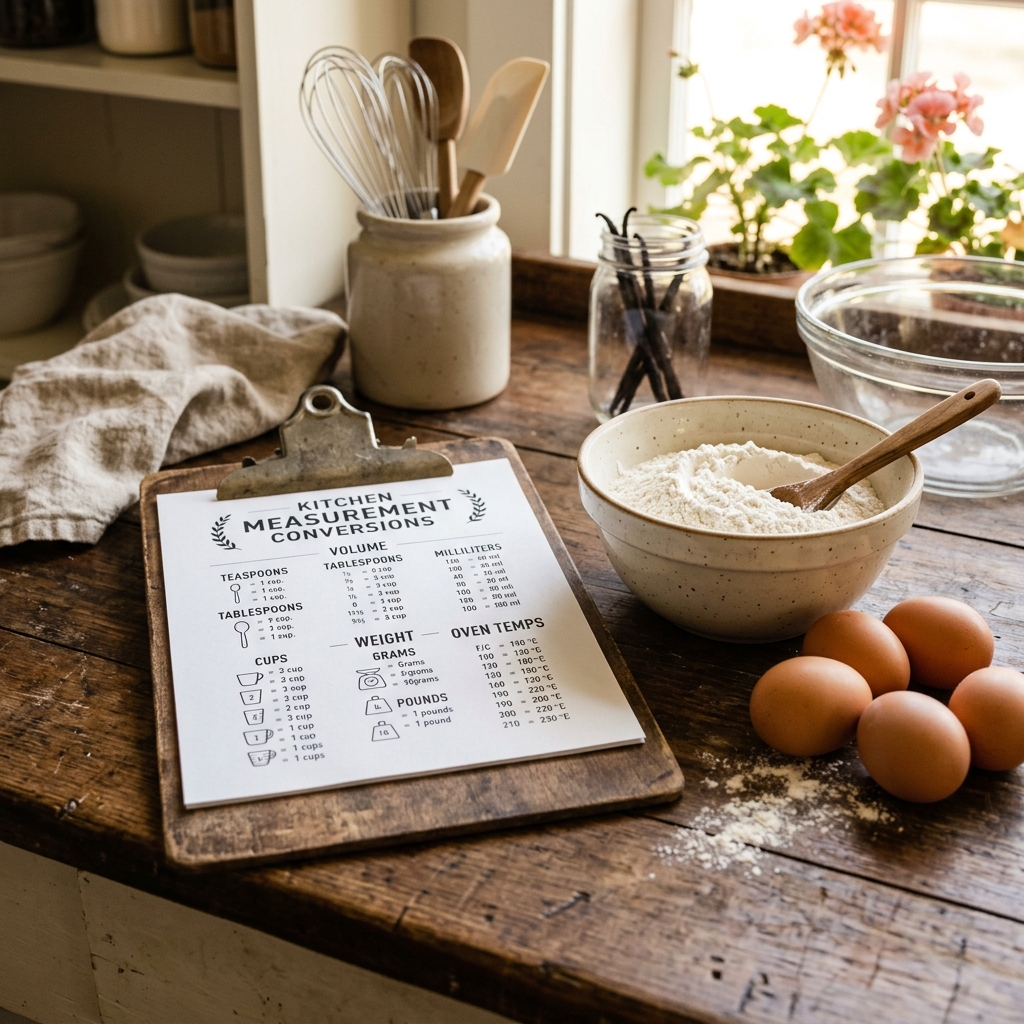
The Master Volume Conversion Chart
Here is a quick cheat sheet for swapping volume measurements in the kitchen:
| Unit | Equivalent in Tablespoons | Equivalent in Teaspoons | Equivalent in Milliliters |
|---|---|---|---|
| 1 Teaspoon (tsp) | 1/3 tbsp | 1 tsp | 4.9 ml |
| 1 Tablespoon (tbsp) | 1 tbsp | 3 tsp | 14.8 ml |
| 1/4 Cup | 4 tbsp | 12 tsp | 59 ml |
| 1/3 Cup | 5 tbsp + 1 tsp | 16 tsp | 79 ml |
| 1/2 Cup | 8 tbsp | 24 tsp | 118 ml |
| 1 Cup | 16 tbsp | 48 tsp | 237 ml |
The Ounce Trap: Fluid vs. Dry
One of the easiest ways to ruin a bake is mixing up fluid ounces (volume) and dry ounces (weight).
Fluid ounces measure volume—how much space something takes up. That's what you see on liquid measuring cups. Dry ounces measure weight—actual mass—which you need a scale to measure.
If you're measuring water, you're in luck: 8 fluid ounces of water weighs exactly 8 ounces. But for dry ingredients, the rule completely breaks down. A cup of flour occupies 8 fluid ounces of space, but it only weighs about 4.2 ounces. Always double-check if your recipe is asking for weight (ounces) or volume (fluid ounces).
Fluid ounces are for volume, and ounces are for weight. They are not the same thing, unless you're measuring water.
Pints, Quarts, and Gallons
If you're dealing with larger batches, here are the big conversions to keep in mind:
- 1 Cup: 8 fluid ounces
- 1 Pint: 2 cups (16 fluid ounces)
- 1 Quart: 2 pints (4 cups)
- 1 Gallon: 4 quarts (16 cups)
Inside the Kitchen
Try Our Unit Converter
Tired of trying to do kitchen math on the fly?
Our free Unit Converter Tool makes conversions effortless. It instantly swaps between cups, tablespoons, teaspoons, ounces, grams, and milliliters, so you can keep cooking without the headache.
More Handy Kitchen Tools
Keep your kitchen measurements accurate with these free calculators:
- Unit Converter — Quickly switch between metric and imperial.
- Cups to Grams Converter — Swap volume cups to weight measurements.
- mL and Cups Converter — Easily swap liquid volumes between mL and cups.
- Recipe Scaler — Easily scale your recipes up or down.
Wrapping Up
Knowing your basic kitchen conversions is like having a cheat code in the kitchen. It saves you time, prevents you from dirtying every measuring spoon you own, and keeps your recipes on track. Keep this guide bookmarked, or let our digital calculators do the math for you next time. Happy cooking!
Frequently Asked Questions
Recommended Reading
US Cups vs. Australian Cups: Why Your Recipe Might Be Failing
A US cup is 236.6 ml, but an Australian cup is 250 ml. Here is how that 6% difference can ruin your baking, and how to swap them easily.
How Many Grams Are in a Cup? (It's Not as Simple as You Think)
Looking for a quick way to convert cups to grams? Here is a simple, ingredient-by-ingredient guide to what one cup actually weighs in the real world.
How to Convert Any Recipe from Cups to Grams
Tired of guessing how much a cup of flour actually weighs? Here is how to convert any cup-based recipe to grams so your bakes turn out perfect every single time.