How to Measure Flour Correctly: Spoon & Level vs. Scoop & Sweep
If you are baking and still measuring flour by the cup, I promise you: your results are shifting from batch to batch. Don't blame your oven or your skills—blame the measuring cup.
Here's the secret no one tells you: a 'cup' of flour is a total wildcard. Depending on how you scoop it, you could be adding anywhere from 120 to 160 grams of flour. That is a massive range, especially when you are baking delicate cakes or cookies where the fat-to-flour ratio dictates the entire texture.
Spoon & Level vs. Scoop & Sweep
- ›Spoon & Level (Correct): Fluff the flour, spoon it into the cup, and sweep it level. Yields ~120g - 125g.
- ›Scoop & Sweep (Incorrect): Dipping the cup straight into the bag compacts the flour. Yields ~145g - 160g (up to 30% too much flour).
- ›Best Practice: Use a kitchen scale and measure flour in grams for 100% accuracy.
Convert Flour Cups to Grams
Skip the guessing game. Use our free Cups to Grams Converter to find the exact gram weight for any type of flour instantly.

How to Spoon & Level (The Right Way)
This is what most recipe authors assume when they write '1 cup of flour.' Here is how to do it correctly:
- Fluff the flour. Give the flour a quick stir in the jar or bag with a fork or whisk. Flour packs down as it sits, so you need to loosen it up.
- Spoon it in. Gently scoop flour with a spoon and sprinkle it into your measuring cup. Never dig the cup straight into the flour.
- Scrape it flat. Sweep the flat edge of a butter knife across the rim to clear the excess.
Using this method, a cup of all-purpose flour should weigh around **125 grams**, which is the commercial standard most cookbooks are written with.
Spooning and leveling gives you about 125g of flour per cup. Scooping directly with the cup packs in 150g or more—and that extra flour will ruin a recipe.
Why the Plunge Method Fails
Plunging the cup straight into the bag is what most of us do when we're in a rush. You dig the cup in, get a heaping pile, and scrape it flat.
The problem here is compression. Plunging the cup acts like a trash compactor. You end up with up to 160 grams of flour crammed into that cup, especially if the bag has settled.
That doesn't sound like a lot, but let's look at the math. Say a recipe wants 3 cups of flour. Spooned and leveled, that's 375 grams. Scooped directly, it could easily be 465 grams. That is almost 100 grams of extra flour dumped into your bowl. It's the reason cookies turn out like dry biscuits, cakes look dense, and bread feels like leather.
| Method | All-Purpose | Bread Flour | Cake Flour | Whole Wheat |
|---|---|---|---|---|
| Spoon & Level | 125g | 130g | 115g | 130g |
| Scoop & Sweep | 150g+ | 155g+ | 140g+ | 155g+ |
| Kitchen Scale | 125g | 130g | 115g | 130g |
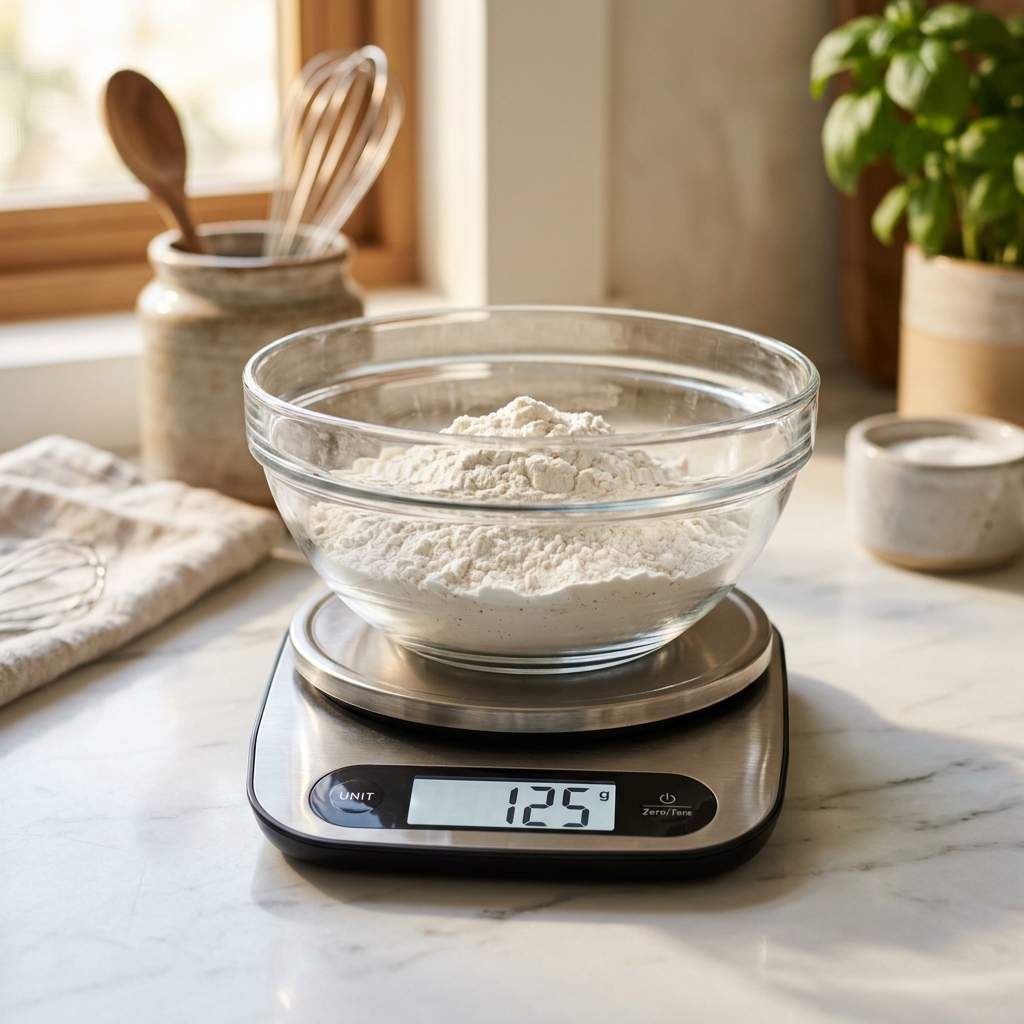
Baker's Rule
Why Weight Wins Hands Down
It comes down to this: volume is a guess. Weight is a fact. A cup measures space, but flour changes shape depending on gravity and moisture. You can compress it, fluff it, or sift it, and it will occupy different volumes.
Grams never change. 125 grams of flour is the exact same amount of flour whether it's packed down, sifted, or fluffed up. There's no technique to master and no brand differences to worry about.
Plus, a digital kitchen scale costs about $15, takes up zero space, and saves you from washing measuring cups. It's a no-brainer.
Measuring Mistakes to Watch Out For
Even seasoned home cooks fall into these traps. Here are the main measuring errors to avoid:
Try Our Converter
Ready to bake with confidence? Use our free Cups to Grams Converter to swap flour cups to grams. Zero your scale, weigh your ingredients, and enjoy perfect bakes.
More Baking Tools
Keep your kitchen measurements accurate with these free tools:
- Cups to Grams Converter — Convert cups of baking ingredients to grams.
- Grams to Cups Converter — Convert weights back to volume cups.
- Unit Converter — Convert between metric and imperial units.
- Recipe Scaler — Scale recipe servings up or down.
The Bottom Line
If you want perfect, consistent bakes, buy a kitchen scale. Until then, make spooning and leveling your gold standard. And remember, since different recipe authors scoop differently, their 'cup' might not match yours. It's not a failure on your part—it's just the limits of measuring cups.
Frequently Asked Questions
Recommended Reading
Butter Measurements Explained: Sticks, Cups, Grams and Tablespoons
How much is a stick of butter? We break down the math for sticks, cups, grams, tablespoons, and ounces, plus look at European vs. American butter.
Almond Flour vs. All-Purpose Flour: Can You Substitute Them 1:1?
Thinking of swapping all-purpose flour for almond flour? It's not a simple 1:1 trade. Here's how to adjust your recipe with the right ratio, extra eggs, and temp settings for baking success.
Bread Flour vs. All-Purpose Flour: When to Make the Switch
Wondering if you can swap all-purpose flour for bread flour? Here is how protein content and water absorption change your bakes, plus how to convert them.