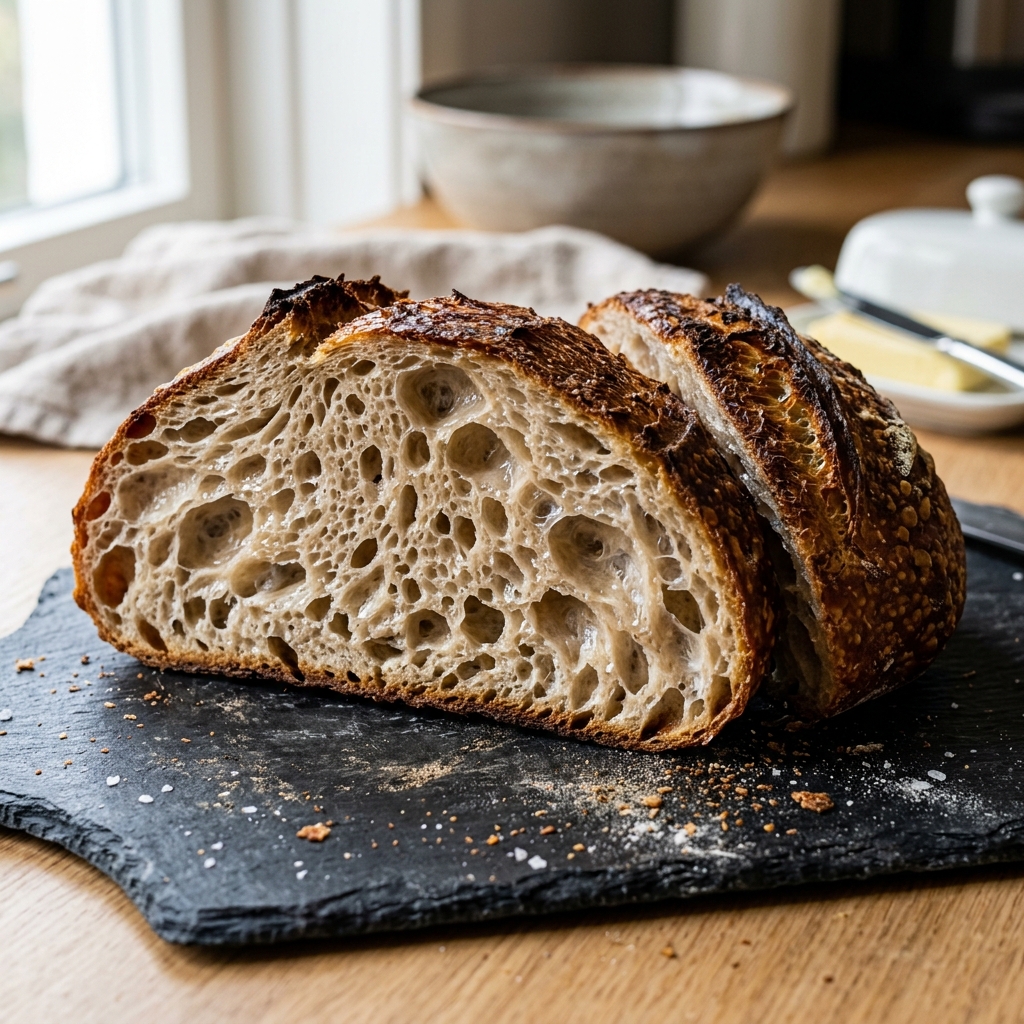
High-Hydration Sourdough Bread
Learn how to bake a beautiful high-hydration sourdough loaf at home. Follow our simple, step-by-step method to get a perfect open crumb, crispy caramelized crust, and that signature sourdough tang.
Ingredients
Gives the dough enough strength to hold a higher water content.
Adds a nice rustic flavor and helps feed the sourdough starter.
Filtered water is best so chlorine doesn't slow down your starter.
Make sure it is bubbly and active, fed about 4-6 hours before you start.
Keeps the dough stable and brings out the flavor.
Step-by-Step Instructions
Let the Flour Hydrate (Autolyse)
In a large bowl, mix the 450g of bread flour and 50g of whole wheat flour with 370g of the water (keep 20g of water aside for later). Stir until all the flour is wet and no dry spots remain. Cover the bowl with a damp cloth and let it rest on the counter for 45 minutes.
This resting step allows the flour to fully absorb the water. It starts building dough strength naturally, so you won't have to knead it as much later.
Add the Starter and Salt
Pour the 100g of active starter over the dough. Use your fingers to dimple it in, then fold the dough over itself until combined. Cover and let it rest for 20 minutes. Next, sprinkle the 10g of fine sea salt and the remaining 20g of water over the dough. Squeeze the dough with your hands to fully dissolve and work the salt in.
Adding salt after the initial rest is a game changer. Salt can make it harder for flour to absorb water, so waiting until now gives you a much stronger dough.
Stretch and Fold During the Rise
Over the next 4 hours, you'll do 4 sets of stretches and folds, spaced 30 minutes apart. Wet your hands so the dough doesn't stick. Grab one side of the dough, pull it up gently, and fold it over the center. Turn the bowl a quarter turn and repeat. Do this on all four sides to complete one set. Let the dough rest covered in a warm spot (around 78°F) for the remaining 2 hours.
Stretching and folding replaces traditional kneading. Every fold traps air bubbles inside the dough, which is what gives your baked bread those beautiful, airy pockets.
Pre-shape and Let It Rest
Gently tip the dough out onto a clean, unfloured counter. Slide a bench scraper underneath and gently shape it into a round ball, pulling it toward you to tighten the outer skin. Dust the top lightly with rice flour and let it sit uncovered on the counter for 20 minutes to relax.
This bench rest lets the dough relax before final shaping. Pre-shaping builds a solid base so your loaf doesn't spread out flat in the oven.
Final Shape and Overnight Chill
Flip the dough over. Pull the bottom edge up, fold the sides inward, and roll it down from the top into a tight log shape. Place the dough seam-side up into a proofing basket dusted with rice flour. Pop the basket inside a plastic bag and let it rest in the fridge (about 38°F) for 12 to 16 hours.
An overnight chill slows down the rise, giving the dough time to develop that deep, complex sourdough flavor. It also firms up the dough, making it much easier to score right before baking.
Bake in a Preheated Dutch Oven
Preheat a heavy Dutch oven inside your oven to 450°F (232°C) for a full hour. Turn the cold dough out onto parchment paper. Make one deep slash down the center at a slight angle. Carefully lower the dough into the hot Dutch oven. Bake covered for 20 minutes. Take the lid off, lower the oven to 425°F (218°C), and bake for another 22-25 minutes until the crust is deeply browned.
Baking with the lid on traps steam around the dough. This keeps the crust soft at first so the bread can rise fully. The slash gives the bread a clean path to open up.
Nutritional Profile
Macros listed below scale dynamically based on the serving size selected in the recipe card.
Kitchen Timer
Need to scale or convert sizes?
This recipe links with our specialized calculators. Use them to calibrate oven dials, adjust brine salinity percentages, or scale baking pans.
Try the Recipe ScalerTechnique Notes
- Hydration is just the ratio of water to flour. For this loaf, 390g of water divided by 500g of flour gives you 78% hydration. If you are new to sourdough, try lowering the water to 350g (70% hydration) to make the dough easier to handle.
- Always weigh your ingredients on a scale. Measuring cups can easily pack too much flour, which throws off your water ratio and makes the bread heavy.
- Clean-up tip: Soak your bowls and tools in cold water first. Hot water cooks the flour residue, turning it into a sticky paste that is hard to scrub off.